


- Estate Planning
- Probate
- 16 mins
Almost every Massachusetts resident can benefit from creating a Trust as part of their estate plan. Trusts are one of the most used estate planning tools, due to the many advantages they provide depending on your estate planning goals. Trusts can help avoid probate court, reduce or possibly eliminate Massachusetts estate taxes, protect assets from the high costs of long-term care, and help preserve a family's home and other assets for future generations. While a Last Will and Testament remains a vital estate planning document, a Trust often provides additional benefits that a Will alone simply cannot achieve.
What Is a Trust?
A Trust is a legal arrangement in which one (or more) person transfers legal title of their assets to a fiduciary who is responsible for managing the Trust assets for the benefit of another person. A Trust has three distinct roles:
- The Settlor: The person(s) creating and establishing the Trust. The Settlor is the one who transfers their own assets to the Trust, and establishes the terms of the trust instrument itself. The Settlor dictates how the trust assets should be held, used, and distributed.
- The Trustee: The person(s) or institution (of a Professional Trustee is named) that manages and controls the Trust assets. The Trustee is bound by strict fiduciary duties to hold and manage the trust assets for the benefit of the beneficiaries. For a comparison of whether you should select an individual or a professional/corporate trustee, read our full legal blog here.
- The Beneficiary: The designated recipient(s) of the Trust property. The beneficiaries can be people, charitable organizations, or other entities.
For a full overview of the different roles associated with an estate plan, read our full “Who’s Who” legal blog here. Trusts can be customized to meet a variety of estate planning goals and can be either revocable or irrevocable.
The two most common types of Trusts used in Massachusetts estate planning are:
- Revocable Living Trusts
- Irrevocable Trusts (more thoroughly defined as MassHealth Income-Only Trusts or Medicaid Asset Protection Trusts)
Each serves different purposes and may be appropriate depending on your assets, family circumstances, and long-term estate planning goals.
Why Do You Need a Trust in Massachusetts?
One of the most common questions estate planning attorneys hear is:
"Do I need a Trust if I already have a Will?"
For most individuals and families, the answer is yes.
A properly designed Trust can provide significant benefits that a Will alone cannot, including:
- Avoiding probate;
- Maintaining privacy;
- Reducing or possibly eliminating estate taxes;
- Protecting assets from long-term care costs;
- Simplifying the administration of assets after death;
- Protecting and appreciating assets for minor children;
- Providing ongoing management for beneficiaries.
Let's examine these benefits in more detail.
Benefit #1: Avoid Probate in Massachusetts
One of the primary reasons people create a Trust is to avoid probate.
A common misconception we hear from clients is the idea that having a Will alone will avoid the need for probate. This is incorrect. A Will ensures that you can dictate whom you desire to inherit your assets, rather than your estate being left to the intestacy statute (click here to read our full legal blog about the Massachusetts Intestacy statute and what happens if you die without a Will). However, if a Will is the only estate planning document that you have, it must still be submitted to Probate Court, opening up your estate to unnecessary court fees, legal fees, delays, and creditor claims.
Probate is the court-supervised process of administering a deceased person's estate. While probate is often necessary when assets are owned individually, assets properly titled in the name of a Trust generally pass outside of probate.
Why Is Probate Often Undesirable?
Filing probate in Massachusetts takes significant time, money, and cooperation amongst loved ones before anyone entitled to inherit from the estate can actually receive anything. Filing probate requires:
- Preparation and filing of numerous probate court documents;
- Mandatory waiting periods;
- Strict notification requirements to interested parties and Massachusetts agencies;
- Filing a publication in the newspaper;
- Significant legal fees and court fees;
- Monitoring creditor claims during the statutorily defined window;
- Dealing with family disputes or legal objections filed with the Probate Court;
- Filing additional petitions as needed (such as a Petition to Sell Real Estate);
In Massachusetts, even relatively straightforward probate proceedings where all legal heirs get along can take several months just to get a Personal Representative appointed.
How a Trust Avoids Probate
When assets are transferred into a Trust during your lifetime, the Trustee, and not you individually, becomes the legal owner of those assets. Probate is only necessary if you die with assets in your individual name. A Trust gives you a mechanism to remove those assets from your individual name (thus removing them from your probate estate), but still maintain full control of those assets while you are alive.
In a common Revocable Trust structure, both you and your spouse will establish the Trust as Settlors and serve as the Trustees while you are alive. Upon your death, the successor Trustee immediately steps in to administer and distribute Trust assets in accordance with the Trust terms without any probate court involvement whatsoever.
Many families in Massachusetts will place their primary residence, along with any vacation or investment properties they own in other states, into a Revocable Trust to avoid the need for probate court and to streamline the transfer of their property to their beneficiaries. It is especially important to place out-of-state property into a Revocable Trust to avoid what is called ancillary probate, which is the process of filing probate first in Massachusetts, and then again in the second "ancillary" state where the real estate is located. Below is a sample flowchart highlighting a common plan that utilizes both a Pour-Over Will along with a Revocable Trust.

A Real-Life Example:
John owns a home in Braintree worth $800,000 and has investment accounts totaling $500,000. John is unmarried but has two children.
If John dies owning these assets in his individual name, his children will have to file probate in order to inherit both assets.
If John transfers those assets into his Revocable Trust during his lifetime, he could name one, or both, of his children as successor Trustees, where they would immediately be able to liquidate both assets and distribute them in accordance with the terms of the Trust without any need for probate.
Benefit #2: Reduce or Eliminate Massachusetts Estate Taxes
Many Massachusetts residents are surprised to learn that Massachusetts imposes its own state-level estate tax. There are currently only 12 states along with the District of Columbia that impose a state-level estate tax. The Massachusetts exemption is currently set as $2 Million Dollars per individual.
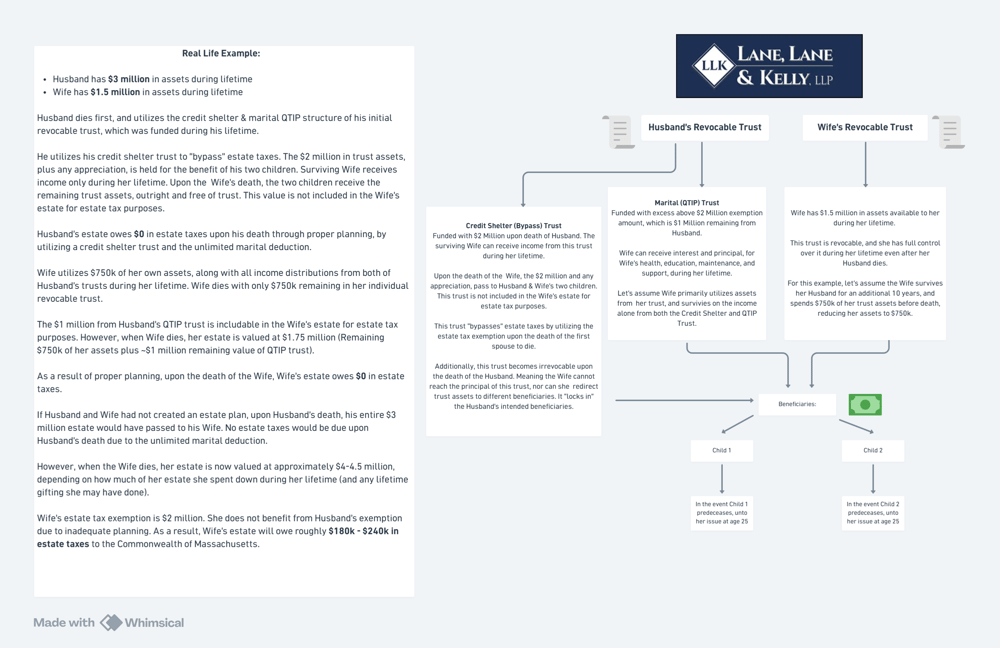
For married couples, this amount does not “double” automatically. Meaning if one spouse passes away and their entire estate is left to the surviving spouse, no estate tax will be due upon the death of the first spouse to die due to the unlimited marital deduction. However, an estate tax will surely be due upon the death of the surviving spouse, as their individual exemption will remain $2 Million Dollars (unless this exemption is increased in the future).
Through proactive Trust planning, couples can incorporate what is commonly referred to as a Credit Shelter Trust structure (sometimes referred to as Bypass or AB Trust) which preserves each spouse’s exemption amount, which in effect will double the exemption to $4 Million for a married couple.
There is also a Federal Estate Tax Exemption amount, which is currently set at $15 Million Dollars regardless of where you reside permanently. Unlike Massachusetts, the Federal Exemption allows for “portability” between spouses. In short, this means that automatically and without any proactive trust planning, a surviving spouse can claim and “port” over any unused exemption amount of their deceased spouse, effectively doubling this exemption to $30 Million Dollars.
With the appreciated prices of real estate in Massachusetts alone, many middle-class and upper-middle class families will face potential estate tax exposure without even realizing it. For perspective, if your gross, taxable estate is valued at approximately $4 Million Dollars, then when you and your spouse die, your estate will be subject to approximately $180,800.00 Dollars in estate tax liability. With proactive Trust planning, this tax liability could not only be significantly reduced, but eliminated entirely.
Why Estate Tax Planning Matters
Proactive Trust planning can save families hundreds of thousands of dollars in potential estate tax. It is important to review your asset portfolio with an estate planning attorney at Lane, Lane & Kelly so they can advise you on the best strategy for your situation.
If your estate is valued anywhere between $2 Million (the Massachusetts exemption) and $15 Million (the Federal exemption), then your estate will be subject to a significant state-level tax. The marginal rates for the Massachusetts estate tax range from 8%-16%.
Your “estate” will include the value of all of your assets, including:
- Any and all real estate located in Massachusetts (whether its your primary residence, a vacation home, or an investment property);
- Retirement accounts;
- Investment portfolios and brokerage accounts;
- Life insurance proceeds;
- Business interests.
The estate tax calculation will not include any non-Massachusetts real estate, which is a very important planning mechanism. For an overview of how to account for out-of-state real estate when it comes to estate planning and the Massachusetts exemption, read our full legal blog here. Without proper planning, your family may face a substantial Massachusetts estate tax liability that will be owed to the Commonwealth upon your death. Strategic Trust planning will allow you to preserve more wealth for children and grandchildren for generations to come.
For a through real life example of this proactive trust planning in action, see the flowchart below:
Benefit #3: Protect Your Home from Nursing Home Costs and MassHealth Estate Recovery
For many Massachusetts families, protecting assets from the high costs of long-term nursing home care is one of their biggest concerns. Through an Irrevocable Income-Only Trust (IOT), families can potentially protect the entire equity value of their home, and any other assets placed into the Trust, from being used to pay for their care or satisfy any MassHealth estate recovery lien.
The Cost of Long-Term Care
Nursing home costs in Massachusetts can easily exceed six figures annually. Private pay for nursing home residents can range anywhere from $13,000 - $25,000 per month.
A prolonged stay in a nursing facility can rapidly deplete savings that took a lifetime to accumulate.
What Is MassHealth Estate Recovery Lien?
MassHealth (the Medicaid program in Massachusetts) will cover the full cost of your long-term care so long as you meet strict eligibility requirements (which include both financial and medical criteria). However, the Commonwealth of Massachusetts may seek reimbursement for benefits paid on behalf of a MassHealth recipient after their death. This is typically done through a MassHealth estate recovery lien.
In many situations, the Commonwealth can pursue estate recovery against assets that remain subject to recovery under applicable state laws and regulations. One of the easiest targets of an estate recovery lien is any real estate owned by the MassHealth recipient.
For homeowners, this can create significant concerns regarding the future transfer of the family home.
How an Irrevocable Trust Can Help
The single best way to protect your assets, whether consisting of real estate assets or financial assets, is to transfer these assets to an Irrevocable Medicaid trust. These types of trusts are sometimes referred to as MassHealth Income-Only Trusts (IOT).
The drafting and creation of these trusts requires a very specific structure, and must be meticulously crafted to avoid potential pitfalls down the road. It is important to note that this level of planning requires the assistance of an experienced attorney with extensive knowledge in the area of long-term planning. Failing to craft an Irrevocable Trust with the right language will result in the nullification of any transfers to the trust. This could result in a period of ineligibility, or even worse, the trust assets being deemed as “countable” assets for purposes of MassHealth eligibility, even if the 5-year look-back period was met.
This type of planning requires significant thought and consideration, as it won’t provide any benefit unless the transfer of assets to the Irrevocable Trust occurs outside of the MassHealth 5-year look-back period.
The 5-year look-back period is a regulation that allows MassHealth to review a full 60 months of your transaction history when applying for MassHealth benefits. If transfers to your Irrevocable Trust occurred within that 5-year period, then those assets will be “countable” for MassHealth purposes, and they will not be fully protected until the 5-year period is met.
Benefit #4: Asset Protection for Beneficiaries
Unlike a Will, a Trust can provide significant protection for children and other beneficiaries, especially if you have minor children. A Trust allows you to control the manner in which the Trust assets are distributed and when distributions are authorized. For example, couples with minor children will often specify an age, such as 25 or 30, that must be met before their children can receive an outright inheritance.
There are additional benefits, however, to holding assets in Trust rather than distributing them to a beneficiary outright. This is true whether your children are minors or adults.
Rather than distributing assets outright, a Trust can:
- Specify distributions at certain ages or upon a beneficiary attaining a certain milestone (graduating from college or buying a home);
- Protect assets from creditors through the use of a spendthrift provision;
- Help preserve assets in the event a beneficiary of the Trust is going through a divorce;
- Provide assets to beneficiaries that require special needs or who are actively receiving governmental benefits;
- Ensure responsible use of inherited wealth.
This flexibility is often unavailable through a Will or simple beneficiary designations alone. Beneficiary designations directly on your financial accounts naming someone individually can be especially harmful, as those funds will be distributed outright with absolutely no guardrails in place to protect that beneficiary.
Check out other legal blogs from Lane, Lane & Kelly below that dive into these topics in greater detail:
- How to Protect Your Child’s Inheritance from Divorce in Massachusetts
- How Trusts Can Help Parents Plan & Save for Their Children's Education
- What Is a Supplemental or Special Needs Trust and What to Know About Them in Massachusetts
- Why Parents Should Consider a Pot Trust Structure for Minor Children
Benefit #5: Plan for Incapacity
A Trust is not only useful after death.
If you become incapacitated due to illness, injury, or cognitive decline, a successor Trustee can often step in and manage Trust assets without requiring court involvement.
This can provide continuity and reduce stress for family members when difficult or emotional circumstances arise.
Do You Need a Revocable Trust or an Irrevocable Trust?
The answer depends entirely on your goals and your unique situation. There are significant Pros and Cons to consider when contemplating whether a Revocable or Irrevocable Trust is best for you.
| REVOCABLE TRUST | IRREVOCABLE TRUST |
| PROs | PROs |
|
|
| CONs | CONs |
|
|
Frequently Asked Questions
Do I Need a Trust if I Have a Will?
Likely, yes. A Will directs how assets are distributed but generally does not avoid probate. A Trust will provide probate avoidance and other unique planning benefits that a Will cannot. If you live in Massachusetts and own real estate, it is highly advisable to incorporate a Trust into your estate plan.
What Is the Difference Between a Revocable and Irrevocable Trust?
A Revocable Trust can generally be altered, amended or revoked entirely during your lifetime. This makes a Revocable Trust highly flexible as you retain substantial control over the Trust assets, the beneficiaries and fiduciaries named in the Trust, and the terms of the Trust instrument itself.
An Irrevocable Trust typically cannot be changed, amended, or terminated once established. The Settlor can retain a limited power of appointment, which grants them the ability to make some small administrative changes and reappoint trust principal and undistributed income while alive. They are restricted, however, from terminating the Trust or making changes to the Trust terms outside the scope of the power of appointment.
A very important distinction between these trusts is their level of asset protection from MassHealth. A Revocable Trust does not protect the Trust assets from the costs of long-term nursing home care and a potential estate recovery lien. An Irrevocable Trust does protect against MassHealth, subject to the 5-year look-back period.
Can a Trust Help Avoid Probate in Massachusetts?
Yes. Assets properly titled in a Trust will pass in accordance with the Terms of the Trust without going through the probate process.
Can a Trust Protect My Home from Nursing Home Costs?
In many circumstances, a properly structured Irrevocable Trust can help protect the value of your home from being used to pay for the costs of long-term care. Timing and compliance with MassHealth rules and regulations is critical to preserving this protection.
Can a Trust Reduce Massachusetts Estate Taxes?
Yes. Certain Trust strategies can reduce or potentially eliminate Massachusetts estate tax liability that would otherwise be due depending on the size and composition of an estate.
Is a Trust Only for Wealthy Families?
No. Trusts serve many purposes regardless of the size of your estate. Many Massachusetts families use Trusts to avoid probate, protect a home, provide for minor or adult children, and simplify estate administration, regardless of their net worth.
Speak With an Experienced Massachusetts Estate Planning Attorney at Lane, Lane & Kelly, LLP Today
Every family has different goals, assets, and concerns. Whether your objective is avoiding probate, minimizing estate taxes, protecting your home from nursing home costs, or preserving wealth for future generations, a carefully designed Trust can play a critical role in your estate plan.
The estate planning attorneys at Lane, Lane & Kelly have been helping individuals and families throughout the South Shore, Greater Boston area, and all across Massachusetts create customized Trust-based estate plans since 1938. As a fourth-generation law firm, family is at the heart of everything that we do. Don’t trust just anyone to handle your sensitive estate planning matters. Contact us today to find out why we have consistently been voted by our clients as the top Law Firm on the South Shore of Massachusetts.

If you would like to learn more about Revocable Trusts, Irrevocable Trusts, and other planning strategies that may benefit your situation, contact Lane, Lane & Kelly to schedule your free estate planning consultation today.
This blog is made available for educational purposes only as well as to give you general information and a general understanding of the law, not to provide specific legal advice. By reading this blog you understand that there is no attorney client relationship between you and Lane, Lane & Kelly, LLP.